Thursday, September 23, 2010

Friday, September 17, 2010
Amigurumi Inspiration
The Christmas after I learned how to crochet is one I still feel a bit embarrassed about: it was the year that all my friends and family got ugly, ill-fitting hats as gifts. I was nineteen.
With time and practice, my crochet skills improved and I got a little more imaginative with my creations, but everything I made was rather functional; I never dabbled in the construction of toys.
This amigurumi panda inspired me to change all that. I started a project yesterday and, though I'm unfortunately not ready to post a picture of a finished product quite yet, I'm sure that that photo, once it does come, will be darling. Though, regrettably, probably not as darling as this panda, because my bear actually doubles as an iPod case (I'm sorry! I can't seem to get past the notion that everything I make must be functional!).
Maybe if my friends would just have more babies, I would be inspired to make some toys. Meanwhile, I'm sort of fixated on all these iPod case ideas I've come up with in the last couple days. Spoiler alert: many cute pictures of unique, adorable iPod cases are coming soon.
With time and practice, my crochet skills improved and I got a little more imaginative with my creations, but everything I made was rather functional;
 I never dabbled in the construction of toys.
This amigurumi panda inspired me to change all that. I started a project yesterday and, though I'm unfortunately not ready to post a picture of a finished product quite yet, I'm sure that that photo, once it does come, will be darling. Though, regrettably, probably not as darling as this panda, because my bear actually doubles as an iPod case (I'm sorry! I can't seem to get past the notion that everything I make must be functional!).
Maybe if my friends would just have more babies, I would be inspired to make some toys. Meanwhile, I'm sort of fixated on all these iPod case ideas I've come up with in the last couple days. Spoiler alert: many cute pictures of unique, adorable iPod cases are coming soon.
Thursday, September 16, 2010
Goods & Bads
Bad news: I had to get up very early this morning to take my sister to the airport.
Good news: I (usually) like getting up early. From the airport, I went to Starbucks, ordered a soy latte and a zucchini muffin, and read my book for an hour.
Bad news: My car is having problems. I took it into the dealer for a checkup and to diagnose the reason for the "Check Engine Light" turning on. They found several things wrong, and quoted me over $1000 for everything, parts and labor.
Good news: I called another mechanic in the area and he estimated a much lower price for the labor. So I drove my car to his shop.
Good news: One of my favorite restaurants ever, Ranchos, is just a couple blocks from that auto shop.
Good news: Their soy chorizo torta is just as delicious as I remembered it.
Bad news: I didn't have a car now, so I had to get around using public transport.
Good news: I love using public transport! Especially when I'm not in a hurry. I can relax and read a book!
Good news: I took the bus downtown to a movie theater and saw Toy Story 3! And I liked it!
Good news: I had a lot of free time to go shopping.
Bad news: I didn't find anything that I wanted to buy, a situation that always leaves me feeling sort of relieved but mostly just anxious.
Good news: I had frozen yogurt from the best frozen yogurt place (where I used to work).
Bad news: I didn't feel like writing.
Good news: I did it anyway!
Bad news: The writing I did was in the form of a list of daily events categorized as either "Good news" or "Bad news," which is definitely a cop out, not to mention cheesy.
Good news: I (usually) like getting up early. From the airport, I went to Starbucks, ordered a soy latte and a zucchini muffin, and read my book for an hour.
Bad news: My car is having problems. I took it into the dealer for a checkup and to diagnose the reason for the "Check Engine Light" turning on. They found several things wrong, and quoted me over $1000 for everything, parts and labor.
Good news: I called another mechanic in the area and he estimated a much lower price for the labor. So I drove my car to his shop.
Good news: One of my favorite restaurants ever, Ranchos, is just a couple blocks from that auto shop.
Good news: Their soy chorizo torta is just as delicious as I remembered it.
Bad news: I didn't have a car now, so I had to get around using public transport.
Good news: I love using public transport! Especially when I'm not in a hurry. I can relax and read a book!
Good news: I took the bus downtown to a movie theater and saw Toy Story 3! And I liked it!
Good news: I had a lot of free time to go shopping.
Bad news: I didn't find anything that I wanted to buy, a situation that always leaves me feeling sort of relieved but mostly just anxious.
Good news: I had frozen yogurt from the best frozen yogurt place (where I used to work).
Bad news: I didn't feel like writing.
Good news: I did it anyway!
Bad news: The writing I did was in the form of a list of daily events categorized as either "Good news" or "Bad news," which is definitely a cop out, not to mention cheesy.
Wednesday, September 15, 2010
Missing Moka-shi
I just finished watching the 2008 Japanese film Departures. I did not see it when it first came out, which was a source of much embarrassment to me since, as I was living in Japan and as I have many hip friends in the States who watch a lot of foreign films, I felt even more than usually out of sync with the trends of the times when folks back home would ask, "Oh! Did you see that Japanese movie that won the Academy Award for best foreign film?"
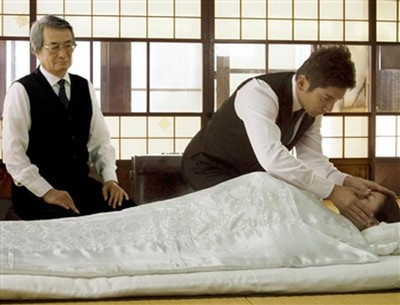
Well, enough about me and my social insecurities. I thought Departures (おくりびと) was lovely. The story line was so well crafted, it was humorous in all the right parts, and best of all, the film demonstrated in both its form and function the acute attention to aesthetic detail that is so much a part of Japanese life and society. Even the ritual of preparing a dead body for burial, in its care and precision, is imbued with meaning and beauty.

I miss Japan so much. The feeling hit me hard and out of nowhere yesterday as I was walking down the street, on my way home from the mailbox. I felt sad and cried a lot the last few weeks that I was in Moka, but yesterday was really the first time since coming back to California that I truly felt the pain of loss. Japan is a marvelous country, and I really didn't start to grasp just how special a place it is until I was no longer living there.
I don't really feel remorseful or depressed about it. My job there wasn't great; often it was terrible. And I have a lot more friends in America than I ever did in Japan. But Japanese culture and society found a permanent place in my heart. I'm grateful that I can continue to learn about Japan and about myself in the context of my association with that nation, even when I'm in the States. And I'm grateful that when I do go back some day, to visit or maybe even to live, it will already be my home.
Well, enough about me and my social insecurities. I thought Departures (おくりびと) was lovely. The story line was so well crafted, it was humorous in all the right parts, and best of all, the film demonstrated in both its form and function the acute attention to aesthetic detail that is so much a part of Japanese life and society. Even the ritual of preparing a dead body for burial, in its care and precision, is imbued with meaning and beauty.
I miss Japan so much. The feeling hit me hard and out of nowhere yesterday as I was walking down the street, on my way home from the mailbox. I felt sad and cried a lot the last few weeks that I was in Moka, but yesterday was really the first time since coming back to California that I truly felt the pain of loss. Japan is a marvelous country, and I really didn't start to grasp just how special a place it is until I was no longer living there.
I don't really feel remorseful or depressed about it. My job there wasn't great; often it was terrible. And I have a lot more friends in America than I ever did in Japan. But Japanese culture and society found a permanent place in my heart. I'm grateful that I can continue to learn about Japan and about myself in the context of my association with that nation, even when I'm in the States. And I'm grateful that when I do go back some day, to visit or maybe even to live, it will already be my home.
Monday, September 13, 2010
9,999 hours to go...
"In the face of frustration, your best tool is a few deep breaths, and remembering that you can do anything once you've practiced two hundred times. Seriously."When I read it a week ago, this quote was a healthy reminder of a concept that I've encountered elsewhere before: that progress is the product of repitition. And though practice--in my experience--doesn't usually make perfect, practice almost always does make passably decent.
--from page 1 of The Daring Book For Girls
I listen regularly to the podcast published by WNYC's RadioLab. It's pretty entertaining and consistently fascinating stuff. On the 07/26/10 short episode, "Secrets of Success," one of the show's hosts interviews Malcolm Gladwell, who discusses the idea that in order to be good at something, you must practice at least 10,000 hours. According to Gladwell, geniuses, from Bill Gates to Mozart to Wayne Gretzky, are not so much people who have been endowed by fortune with superlative skills or talents, as they are people who possess "an extraordinary love for a particular thing." Because of their love for whatever it is they do, they are so consumed by it that they only can devote themselves and their time fully to it.
Today was the first day (of, I'm sure, many to come) that I considered not updating this blog. I just didn't have anything interesting to write, and I couldn't think of any good stories from my past to transcribe, either. I wanted to just let it slide, shrug it off as one day lost, and get back to finishing season one of Heroes.
But I couldn't.
Remaining faithful to this 365-day blogging program is not just about integrity or proving a point. I'm really trying to improve myself here. And I don't honestly think that, if I spend 10,000 hours writing, I'll be able to write the Great American Novel; but I do believe that I'll be a better writer.
Sunday, September 12, 2010
Naked in Nippon
This morning, as I sat beside the fire ring with three friends who had accompanied me on a weekend camping trip, I told a humorous story from my experiences in Japan. The telling of it reminded me that it's a tale I've yet to set down in writing. Though the punchline might seem anticlimactic to Japanese readers, my own compatriots are likely to get a kick out of it.
Earlier this year, I went hiking in Nikko National Park with my American friend Josiah, my South African friend Marius, and my Japanese friend Atsuki. It was a very pleasant hike, about four hours along a fairly level path, ending at a train station where we could easily catch a ride back to the trail head, where Atsuki's car was parked. Also near the end of the trail was a large, slightly famous and rather upscale hotel, with a proportionately famous and upscale onsen attached to it.
An onsen is a Japanese-style communal bath house. Traditionally, they are built around the offshoot of a natural geothermic hot spring, but many present-day onsen simply pipe in heated tap water. Though these bathhouses vary significantly in size, quality, and style, the system for visiting an onsen is fairly uniform.
The standard onsen is divided into two sections: one for men and one for women. After paying the entrance fee, men and women go through separate doorways, usually concealed by a blue curtain for males and a red curtain for females. After passing though the curtain, the customer enters a room in which she undresses completely and leaves her clothes and personal items in a locker or basket or cubby. Next, she proceeds to a room where she washes herself very thoroughly with soap. After completely rinsing off, she enters a steaming hot bath for soaking. Depending on the onsen, there may be just one bath or there may be multiple baths of different styles, temperatures, or even aromas. Some may have massage jets or bubbles, and there might even be waterfalls, saunas, and beautiful outdoor (but still appropriately private) settings. The visitor to the onsen will probably find the intense heat a little too overwhelming to stay in the baths more than an hour or so and, after completing her soak, will once again wash herself thoroughly with soap before returning to the locker room. All of these steps are done in the company of fellow same-sex bathers and, though potentially awkward for the unseasoned foreigner, make for a deeply relaxing experience.
I love onsen, and, on that day in Nikko as my fellow hikers and I made our way down that scenic path, the four of us agreed to visit the hot spring at the hotel before taking the train back to the trail head.
As we neared the end of the hike, the conversation was about on the different types of onsen that exist in Japan and Atsuki mentioned something I had heard of only once before: that there are, in some places, "mixed" onsen--called konyoku--where men and women bathe together in the same area. Atsuki said that such establishments, however, were very rare these days and he had never actually seen one.
We came to a bridge that marked the end of our hiking trail. The bridge stretched over a wide river. As we walked across, we could see, about eighty yards away on the opposite river bank, the back of the hotel. And there, along the back of the hotel, was the onsen.
"Oh my gosh, guys, look."
It appeared to be only the men's baths that were visible from the bridge, but there the men were, in full view of anyone who happened to pass along this public space. Given, we were too far away to really see much beyond the obvious fact that they were naked, but we all giggled and agreed that, of the three nationalities represented in our party, Atsuki's was the only one that would find such a setup completely acceptable.
We crossed the bridge and would have to walk along a path and cross another smaller bridge to reach the hotel. We walked up some steps and Atsuki, who was in the lead, suddenly stopped and turned around to face the rest of us. "Guys," he said, "the kind of onsen that we were just talking about--the one with men and women together in the same bath--konyoku--this sign says that there's one right here!"
We were all amazed by the improbability of the coincidence that had just taken place, and prodded one another jokingly about whether we would be willing to give it a try. But, rather than proceed straight forward toward the entrance, we turned the corner there to cross the smaller bridge. I stepped out onto the bridge, glanced to my side, and nearly screamed in shock.
It turns out that the konyoku had an outdoor bath overlooking the riverbank, too. But this time, rather than far enough away to prevent the unassisted eye from discerning any details, the baths were RIGHT THERE, and old naked men sat lounging without a care not fifteen feet from where I stood.
Oh, my. I instantly diverted my eyes. My hiking companions struggled to stifle their shocked laughter and teased me about my bright red cheeks. "That," even Atsuki felt, "isn't normal."
In the end, our perceptions of normal and abnormal are deeply ingrained in our own cultural backgrounds. Living in Japan taught me to reconsider many of my earlier assumptions about what is natural or universal in regards to common human behavior. It was a good learning experience. But there are certain images and situations that, at least for me, will perhaps never cease to be shocking.
To get to the train station, we had to come back across the same bridge and, though I tried to be polite, I admit I got another eyefull in spite of myself.
As much as I love onsen, I don't think that konyoku will ever be my thing.
Earlier this year, I went hiking in Nikko National Park with my American friend Josiah, my South African friend Marius, and my Japanese friend Atsuki. It was a very pleasant hike, about four hours along a fairly level path, ending at a train station where we could easily catch a ride back to the trail head, where Atsuki's car was parked. Also near the end of the trail was a large, slightly famous and rather upscale hotel, with a proportionately famous and upscale onsen attached to it.
An onsen is a Japanese-style communal bath house. Traditionally, they are built around the offshoot of a natural geothermic hot spring, but many present-day onsen simply pipe in heated tap water. Though these bathhouses vary significantly in size, quality, and style, the system for visiting an onsen is fairly uniform.
The standard onsen is divided into two sections: one for men and one for women. After paying the entrance fee, men and women go through separate doorways, usually concealed by a blue curtain for males and a red curtain for females. After passing though the curtain, the customer enters a room in which she undresses completely and leaves her clothes and personal items in a locker or basket or cubby. Next, she proceeds to a room where she washes herself very thoroughly with soap. After completely rinsing off, she enters a steaming hot bath for soaking. Depending on the onsen, there may be just one bath or there may be multiple baths of different styles, temperatures, or even aromas. Some may have massage jets or bubbles, and there might even be waterfalls, saunas, and beautiful outdoor (but still appropriately private) settings. The visitor to the onsen will probably find the intense heat a little too overwhelming to stay in the baths more than an hour or so and, after completing her soak, will once again wash herself thoroughly with soap before returning to the locker room. All of these steps are done in the company of fellow same-sex bathers and, though potentially awkward for the unseasoned foreigner, make for a deeply relaxing experience.
I love onsen, and, on that day in Nikko as my fellow hikers and I made our way down that scenic path, the four of us agreed to visit the hot spring at the hotel before taking the train back to the trail head.
As we neared the end of the hike, the conversation was about on the different types of onsen that exist in Japan and Atsuki mentioned something I had heard of only once before: that there are, in some places, "mixed" onsen--called konyoku--where men and women bathe together in the same area. Atsuki said that such establishments, however, were very rare these days and he had never actually seen one.
We came to a bridge that marked the end of our hiking trail. The bridge stretched over a wide river. As we walked across, we could see, about eighty yards away on the opposite river bank, the back of the hotel. And there, along the back of the hotel, was the onsen.
"Oh my gosh, guys, look."
It appeared to be only the men's baths that were visible from the bridge, but there the men were, in full view of anyone who happened to pass along this public space. Given, we were too far away to really see much beyond the obvious fact that they were naked, but we all giggled and agreed that, of the three nationalities represented in our party, Atsuki's was the only one that would find such a setup completely acceptable.
We crossed the bridge and would have to walk along a path and cross another smaller bridge to reach the hotel. We walked up some steps and Atsuki, who was in the lead, suddenly stopped and turned around to face the rest of us. "Guys," he said, "the kind of onsen that we were just talking about--the one with men and women together in the same bath--konyoku--this sign says that there's one right here!"
We were all amazed by the improbability of the coincidence that had just taken place, and prodded one another jokingly about whether we would be willing to give it a try. But, rather than proceed straight forward toward the entrance, we turned the corner there to cross the smaller bridge. I stepped out onto the bridge, glanced to my side, and nearly screamed in shock.
It turns out that the konyoku had an outdoor bath overlooking the riverbank, too. But this time, rather than far enough away to prevent the unassisted eye from discerning any details, the baths were RIGHT THERE, and old naked men sat lounging without a care not fifteen feet from where I stood.
Oh, my. I instantly diverted my eyes. My hiking companions struggled to stifle their shocked laughter and teased me about my bright red cheeks. "That," even Atsuki felt, "isn't normal."
In the end, our perceptions of normal and abnormal are deeply ingrained in our own cultural backgrounds. Living in Japan taught me to reconsider many of my earlier assumptions about what is natural or universal in regards to common human behavior. It was a good learning experience. But there are certain images and situations that, at least for me, will perhaps never cease to be shocking.
To get to the train station, we had to come back across the same bridge and, though I tried to be polite, I admit I got another eyefull in spite of myself.
As much as I love onsen, I don't think that konyoku will ever be my thing.
Saturday, September 11, 2010
An Apology and a Rant
It's a quarter past nine in the morning and suddenly it hits me: I completely forgot to update my blog yesterday!
Something must be done. The temptation to watch Netflix must be conquered. This blog must be a priority.
I am sorry.
Yesterday, I went with my sister to try on wedding dresses. She and her boyfriend of one million years are tying the knot on January 30, 2011. With my moral support, she was able to find a dress that she is really enthusiastic about. One more item officially checked off of a very long to-do list.
Being around all this wedding business lately, with both my little sisters getting married within six months of each other, has certainly abstracted me further away than ever from the notion that I have much in common with my siblings. I just can't seem to connect with the mindset of The Bride--the compulsory veneration of dresses and engagement rings. After she picked out her dress, Lindsay told me about a wedding gown shop in La Jolla, California where, after a bride decides on a dress, they uncork a bottle of champagne. Brilliant customer relations ploy but, seriously? And, okay, maybe they are doing it a bit ironically, but c'mon...there's something very weird going on here, an enchantment that has collectively flourished in the minds of millions of young couples across the nation. Somehow, hoards of soon-to-be brides (and the friends and families who support them) have espoused the notion that a few hours of one day are not only worth pouring thousands of dollars into, but also that the mundane details of said hours must, accordingly, be regarded with both enthusiasm and respect by all parties involved.
I'm not trying to be cynical here. I'm not anti-marriage, or even anti-wedding, for that matter. But I, at this point in my life, seem to be incapable of mustering the enthusiasm for the particulars of the wedding ceremony that seems to be expected of me. This public confession is sure to come back to haunt me. Humbly I submit that maybe I'm just immature and I'll change my mind about all this once it's my time to get hitched. For the time being, however, I'm inconveniently aloof.
Something must be done. The temptation to watch Netflix must be conquered. This blog must be a priority.
I am sorry.
Yesterday, I went with my sister to try on wedding dresses. She and her boyfriend of one million years are tying the knot on January 30, 2011. With my moral support, she was able to find a dress that she is really enthusiastic about. One more item officially checked off of a very long to-do list.
Being around all this wedding business lately, with both my little sisters getting married within six months of each other, has certainly abstracted me further away than ever from the notion that I have much in common with my siblings. I just can't seem to connect with the mindset of The Bride--the compulsory veneration of dresses and engagement rings. After she picked out her dress, Lindsay told me about a wedding gown shop in La Jolla, California where, after a bride decides on a dress, they uncork a bottle of champagne. Brilliant customer relations ploy but, seriously? And, okay, maybe they are doing it a bit ironically, but c'mon...there's something very weird going on here, an enchantment that has collectively flourished in the minds of millions of young couples across the nation. Somehow, hoards of soon-to-be brides (and the friends and families who support them) have espoused the notion that a few hours of one day are not only worth pouring thousands of dollars into, but also that the mundane details of said hours must, accordingly, be regarded with both enthusiasm and respect by all parties involved.
I'm not trying to be cynical here. I'm not anti-marriage, or even anti-wedding, for that matter. But I, at this point in my life, seem to be incapable of mustering the enthusiasm for the particulars of the wedding ceremony that seems to be expected of me. This public confession is sure to come back to haunt me. Humbly I submit that maybe I'm just immature and I'll change my mind about all this once it's my time to get hitched. For the time being, however, I'm inconveniently aloof.
Subscribe to:
Posts (Atom)